
| Attribute | Value |
|---|---|
| Product Category: | |
| Manufacturer: | Molex |
| Manufacturer Part Number: | Molex 173110-0142 |
| Gender: | Female |
| Housing Material: | Brass |
| Number of Contacts: | 25 |
| Termination Method: | Solder |
| Contact Material: | Copper Alloy |
| Contact Plating: | Gold Over Nickel |
| Insulation Material: | Polybutylene Terephthalate |
| Shielded: | Yes |
| Wire Size: | 20 AWG |
| Current Rating: | 7.5 A |
| D-Sub Shell Size: | S3 |
| Operating Temperature: | -25 to 70 °C |
| Mounting Angle: | Straight |
| Mounting Type: | Panel Mount, Screw Mount |
| D-Sub Connector Type: | Standard |
| SKU: | MOL173110-0142 |
173110-0142

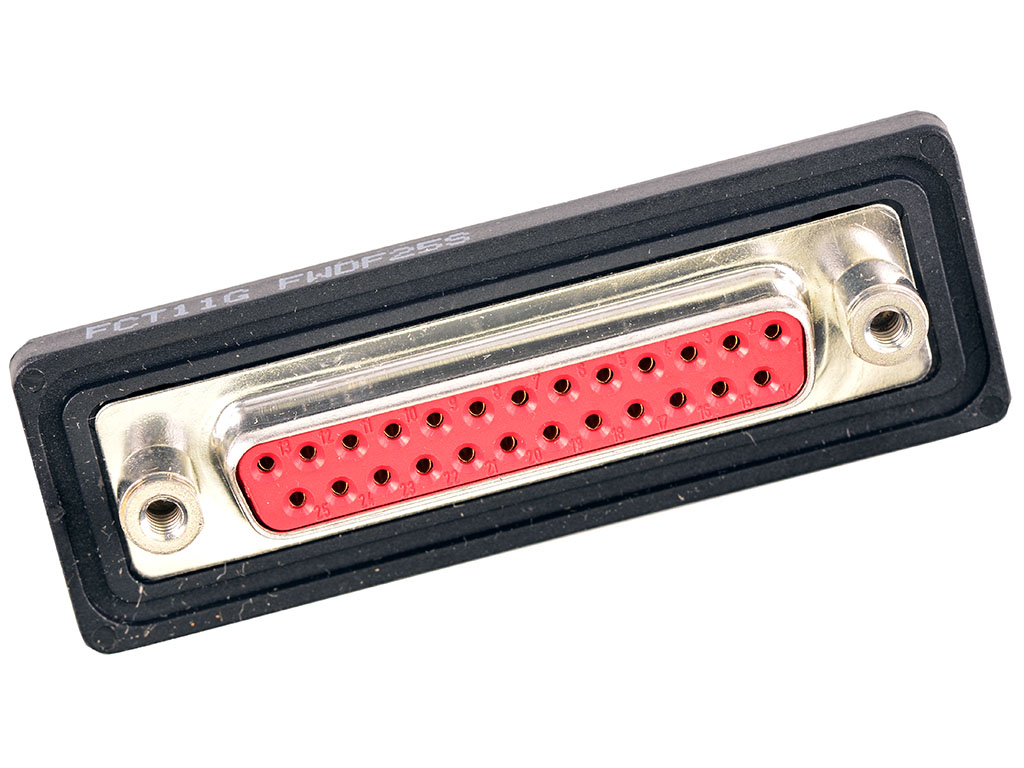
| ICC Number: | MOL173110-0142 |
| Manufacturer: | Molex |
| Manufacturer Number: | 173110-0142 |
| ECAD Model: | |
Description:
FCT Standard-Density Waterproof D-Sub Connector, Female, Straight, Solder Cup, Gold Plating, Front Panel Mount, Plastic Watertight Frame, 25 Circuits, Red Insulator
More >>Specifications
Detailed Description
Introducing the FCT Standard-Density Waterproof D-Sub Connector, a reliable solution for your connectivity needs. This female connector, featuring 25 circuits in a 2-row configuration, is designed for front panel mounting with a durable plastic watertight frame in a striking red color. With gold plating over copper alloy contacts, it ensures high conductivity and corrosion resistance, rated for 7.5 A of current. Operating in temperatures ranging from -25 to 70 °C, and boasting an IP67 rating for dust and waterproofing, this connector is suitable for a wide range of applications. Its straight orientation, solder cup termination, and 2.84 mm pitch offer easy installation, while its tin-plated brass shell provides robustness. RoHS compliant and with a mating cycle of 500, the FCT Standard-Density Connector guarantees long-lasting performance in demanding environments.
Product Change Notice
| Effective Date | Description of Change | Download | |||
|---|---|---|---|---|---|
| 12/31/2026 | 517863 - Change to Product. Data sheet correction: Tighter tolerance specifications are not required from a design perspective and offer no added technical value. Maintaining the current tolerances will also ensure efficient and stable procurement of the items. | Download | |||
Availability
In Stock:
Call
Stock Location:
In Stock
Factory Stock:
Call for Stock
Factory Lead:
Call
Unit Of Measure:
Each
Minimum/Multiple:
1/1
Invalid quantity value

Environmental & Export Classifications
| Attribute | Value |
|---|---|
| RoHS Compliant: | Unkown |